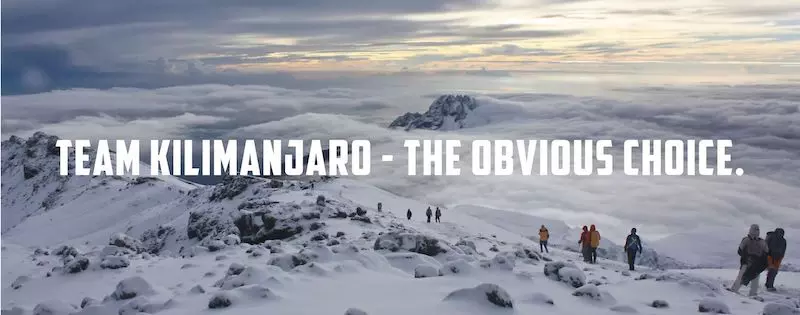
Climb Kilimanjaro with Team Kilimanjaro® – Climbing Africa’s Highest Mountain
Team Kilimanjaro specialises in helping trekkers climb Kilimanjaro safely, successfully, and with optimal acclimatisation.
Welcome to Team Kilimanjaro — the trusted specialist for guided Kilimanjaro routes and high-success expeditions. Plan your 2026 ascent with our expert guides, check current climb costs, learn how long the climb takes, and explore the latest mountain weather insights before you go.
The Ultimate Kilimanjaro Experience – Expert Guidance, Exceptional Success
Join over 12,000 climbers who have tackled Africa's highest peak with Team Kilimanjaro! With a 97.6% summit success rate, we offer expert-guided climbs on exclusive, founder-pioneered routes, designed for optimal acclimatisation and a pristine, crowd-free wilderness experience. Climb Kilimanjaro with our team 👉
Should You Climb Kilimanjaro With Team Kilimanjaro?
When you decide to climb Kilimanjaro, the real question is not whether the mountain is beautiful or whether the summit is technically within reach. The question is far more consequential: Which company can you trust to guide you safely, intelligently, and successfully while you climb Kilimanjaro?
These four questions provide a rational framework for determining which operator is most trustworthy, competent, and aligned with your interests throughout your Kilimanjaro ascent.
Question 1: Can I trust this operator with my safety when I climb Kilimanjaro?
Issue: Safety on Kilimanjaro
Does the operator demonstrate reliable Kilimanjaro safety judgement under uncertainty, or do they depend on comforting but untested assurances?
Rule: What Safety Requires
A company can be trusted when its reasoning has been publicly examined during real risk and when its decisions have protected climbers who climb Kilimanjaro on the most dangerous route configurations.
Application: TK’s Proven Safety Record
In 2006, after three climbers were killed in the Western Breach, authorities could not diagnose the failure. They asked TK’s founder, John Rees-Evans, to lead their officials into the hazard zone, determine the cause, and issue formal recommendations. The Western Breach was subsequently reconfigured according to that analysis. This remains the only operator-led technical investigation ever adopted into Kilimanjaro route governance.
Conclusion: A Trustworthy Safety Standard
If safety is your first priority when you climb Kilimanjaro, TK has already demonstrated the level of reasoning you can rely on during high-consequence decisions.
Question 2: Will this operator maximise my summit chances on Kilimanjaro?
Issue: Maximising Summit Probability
Will my Kilimanjaro climb itinerary be both engineered and executed to improve acclimatisation, preserve stamina, minimise crowding, and avoid unnecessary altitude burden?
Rule: How Summit Success Works
Summit success and safety on Kilimanjaro are not matters of luck. They are determined by altitude architecture, terrain geometry, pacing logic, and an acclimatisation strategy customised to each individual’s optimal balance between two competing variables: 1. pro-acclimatisation exertion, and 2. the preservation of stamina reserves for a summit bid undertaken in a physiologically deleterious high altitude environment.
Application: Engineered Altitude Strategy
TK pioneered seldom-used corridors, created original route variants, and built TK Lemosho as a systematic answer to altitude exposure, stamina waste, terrain geometry, and crowd interference. This evidence-based strategy is corroborated by our proven 97.6% summit success rate - openly verifiable in our live climb reports. Many climbers who don't want to waste their time or money on a random decision choose TK precisely because their margin for error is small as they climb Kilimanjaro.
Conclusion: A Rational Basis for Confidence
If you want more than a theoretical chance of summiting Kilimanjaro, choose an operator whose itineraries are engineered for altitude performance rather than convenience.
Question 3: Will the trek be adapted to me, or must I adapt to the trek?
Issue: Individualised Acclimatisation
Altitude affects individuals differently. When you climb Kilimanjaro, will your guide adjust pace, rest cycles, and altitude stimulus to your personal physiology?
Rule: Why Personalisation Matters
Individual acclimatisation is essential on Kilimanjaro. Groups do not acclimatise; individuals do. An intelligent operator coordinating disciplined guides ensures continual adaptation as you climb Kilimanjaro - maximising your individual safety and summit prospects.
Application: TK’s Individual Logic
TK offers seven distinct support series - from Superlite to VIP Hemingway - allowing the trek to be tailored to each climber’s physiology and goals. Our guides practise individual altitude logic, monitoring gait, sleep quality, appetite, breathing patterns, cognitive response, and morale. Our optimised acclimatisation methods have supported record attempts by Rebecca Nchereri (first female speed climb), Simon Mtuy (men's unsupported speed record), Bran Rees-Evans (youngest person ever to summit Kilimanjaro at 5 years, 136 days - now a TK expedition coordinator), and multiple paraplegic and quadriplegic athletes.
Conclusion: A System Built for People
If you want an operator accustomed to diverse climbers – young, elderly, ultra-fit, anxious, disabled, or ambitious – TK is uniquely positioned to personalise your ascent as you climb Kilimanjaro.
Question 4: Is this an organisation whose character I respect?
Issue: Ethical Stewardship
Do I want my Kilimanjaro ascent associated with this company’s long-term behaviour?
Rule: Why Character Matters
Technical competence is necessary, but not sufficient. An operator should demonstrate long-term stewardship of the mountain and its communities.
Application: TK’s Long-Term Commitments
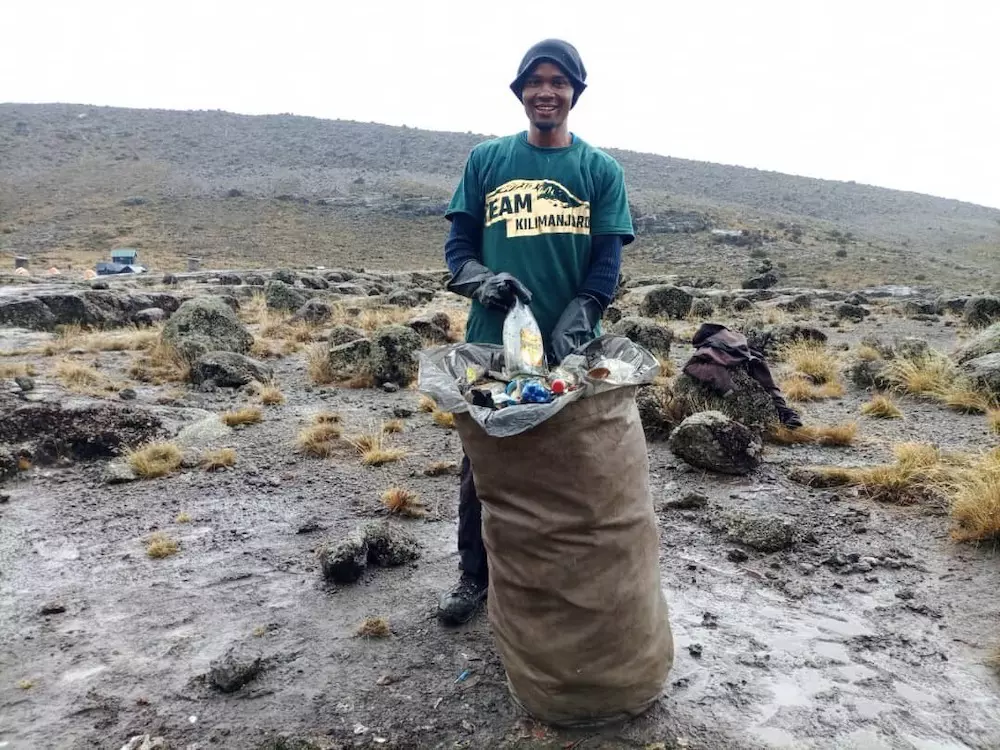
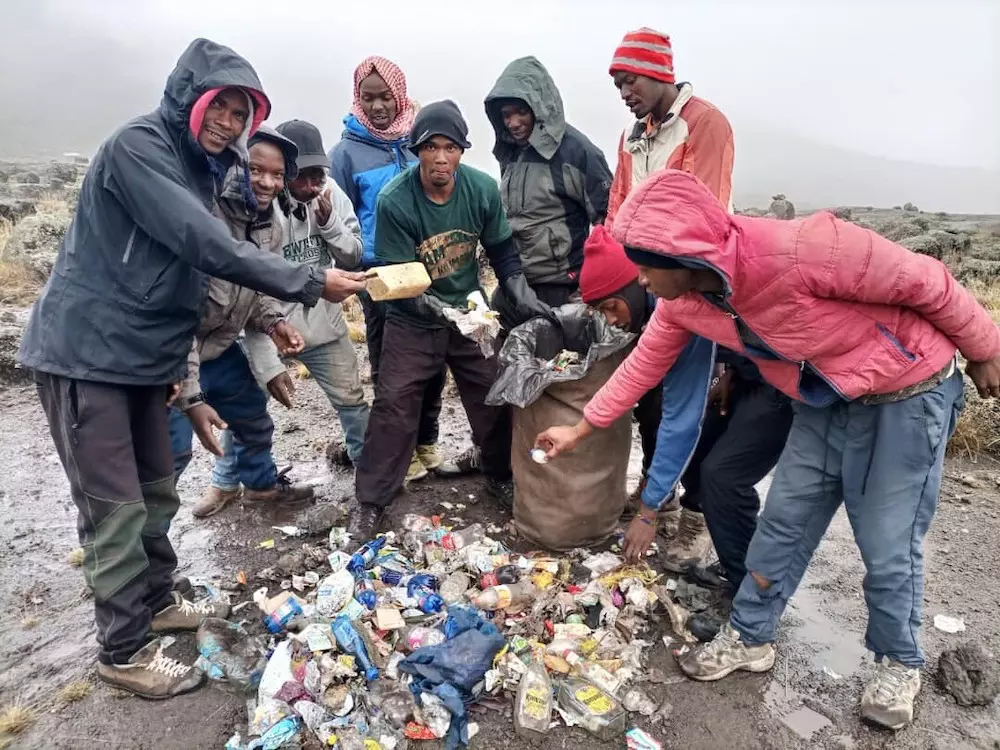
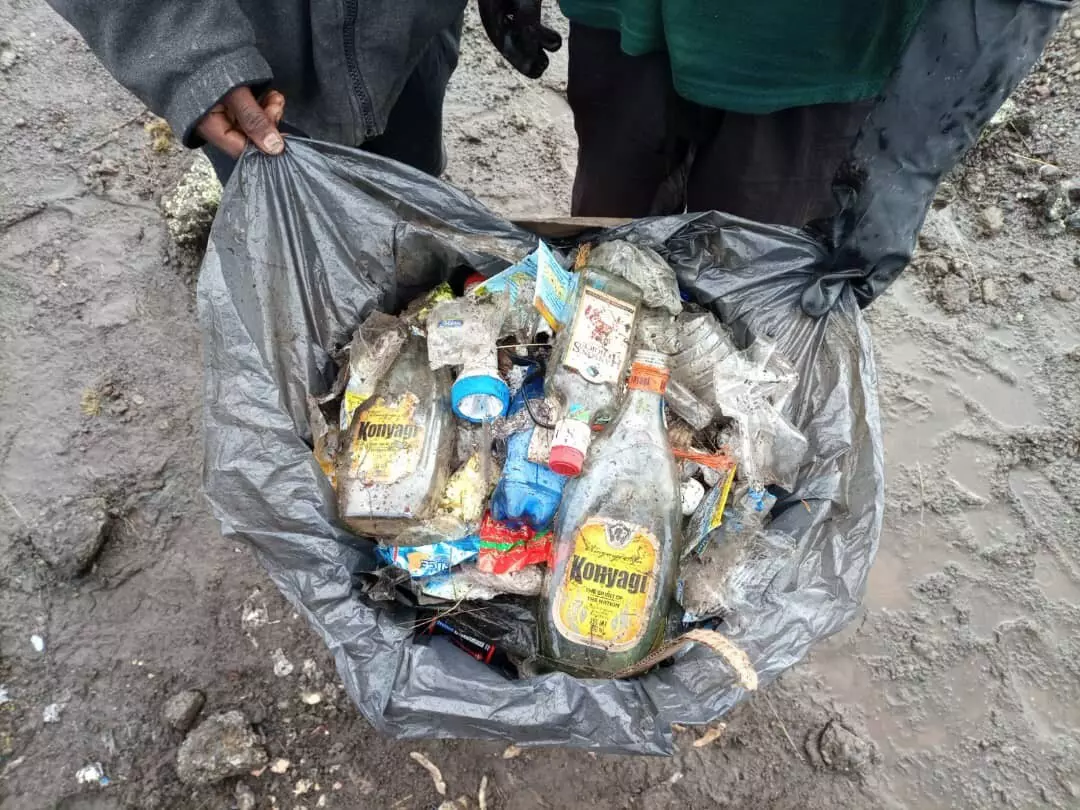
TK maintains environmental and social initiatives such as the Green Porter programme, contributions to glacial-loss mitigation, and deep integration into local communities. High-consequence climbers choose TK not because we are convenient, but because they trust our judgement and our ethics.
Conclusion: Evidence of Integrity
If character matters in choosing an operator for Kilimanjaro, TK offers not just impressions but long-established patterns of stewardship and responsible action.
Final Assessment
These four questions form a rational basis for choosing an operator when you climb Kilimanjaro. On safety, summit probability, individual care, and ethical character, Team Kilimanjaro provides verifiable evidence rather than generic claims. The remainder of this page covers routes, prices, weather, preparation, and altitude guidance so that you can test these conclusions before you climb Kilimanjaro.
Climb Kilimanjaro: Everything You Need to Know
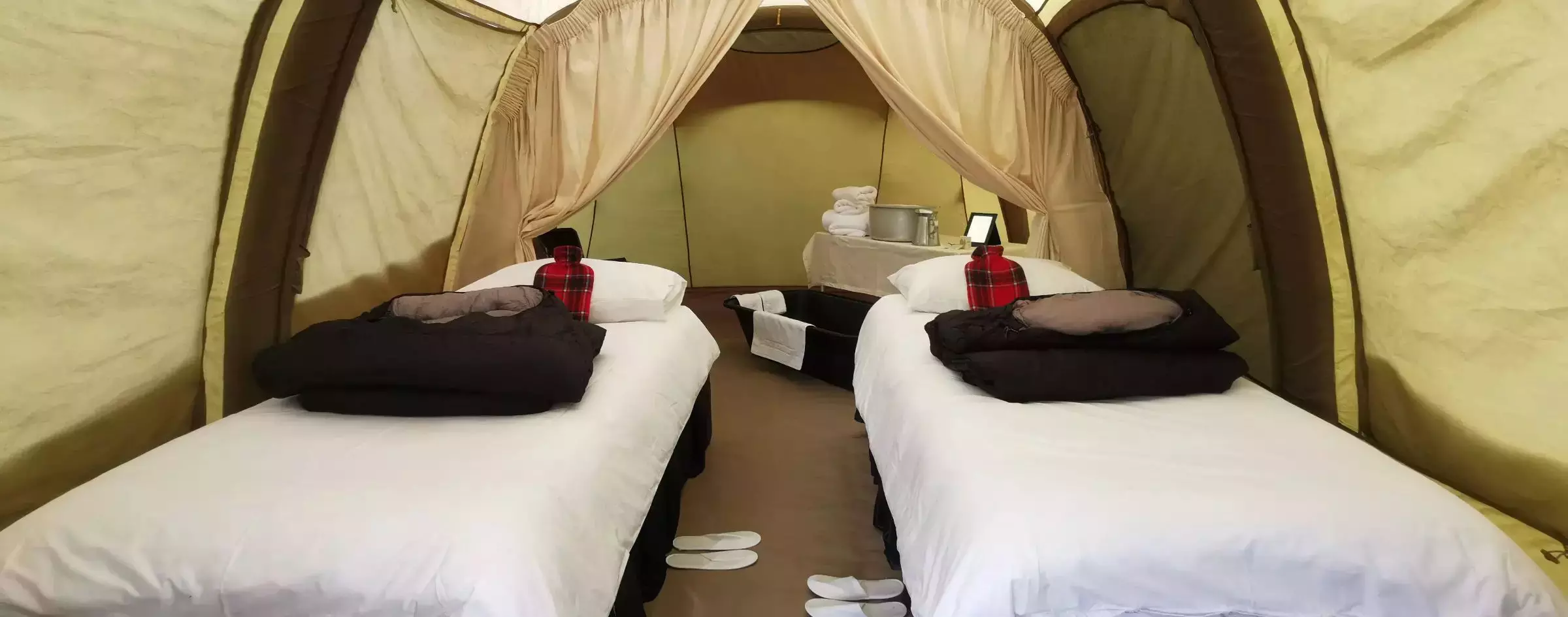
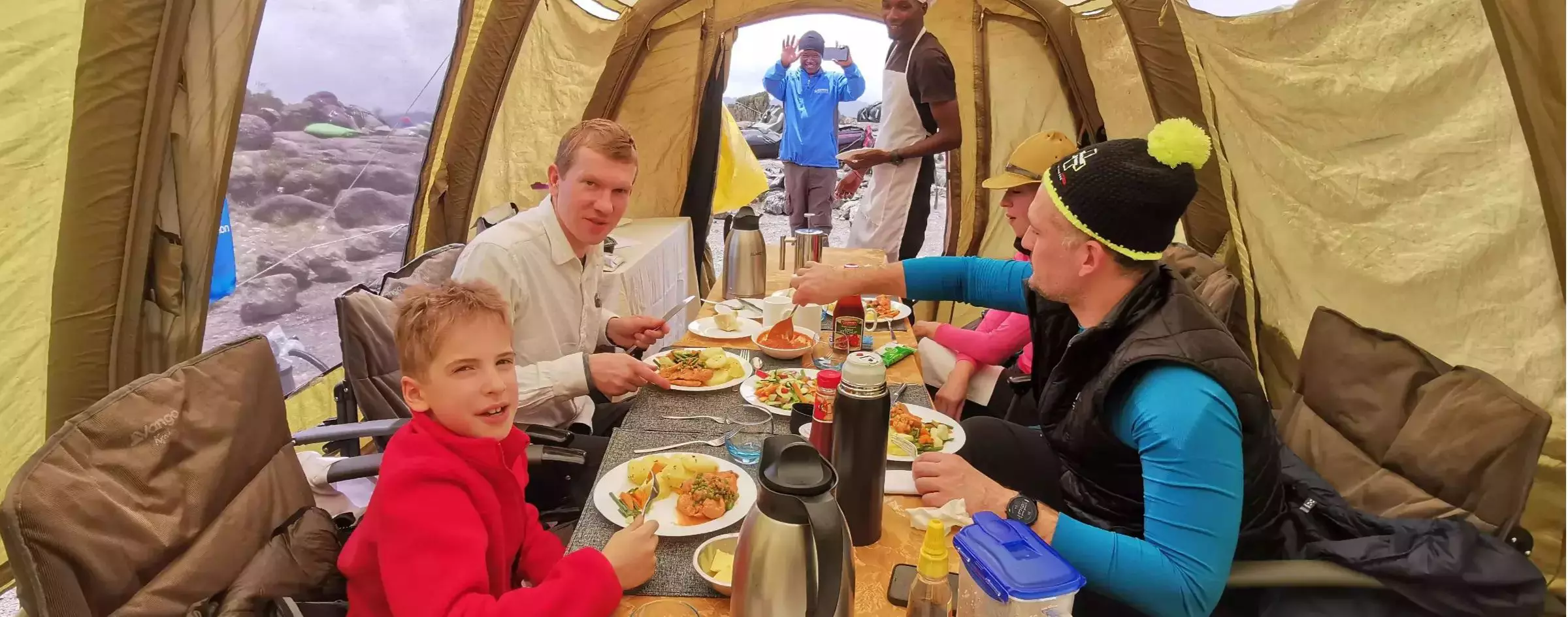
From hardcore minimalists carrying their own gear to luxury seekers enjoying en-suite bathrooms, full-size beds, and fine dining, we tailor every expedition to you.
🎯 Not sure where to start?
We’ll help you choose the best route for your ability, experience, and preferences – in seconds!
✅ Get Your Expedition Recommendation (Quick, hassle-free guide!)
💬 Chat on WhatsApp (Instant expert advice!)
📧 Email Us Now (Fast response guaranteed!)
🧗 What Climbers Say About Us
💬 The most professional, caring, and skilled team on Kilimanjaro! The guides were amazing, and the summit experience was life-changing.
🧭 Best Route - Why TK Has Our Own Routes
By around 2007 TK had come to realise that the standard six routes the authorities permit to be used on Kilimanjaro had serious problems: overcrowding; inadequate acclimatisation / mountain sickness; and needless depletion of stamina reserves prior to the summit bid - a feat many find to be the hardest of their lives.
Kilimanjaro routes comparison 👉
We therefore formulated our own unique route variants that correct these three issues and which have proven to be incredibly successful.
Why it's completely different to climb Kilimanjaro with TK 👉
Or learn more about avoiding the crowds, optimising your acclimatisation, and preserving your crucial stamina reserves for your summit bid.
Learn why TK Lemosho is probably Kilimanjaro's most beautiful route 👉
👊 Who are Team Kilimanjaro?
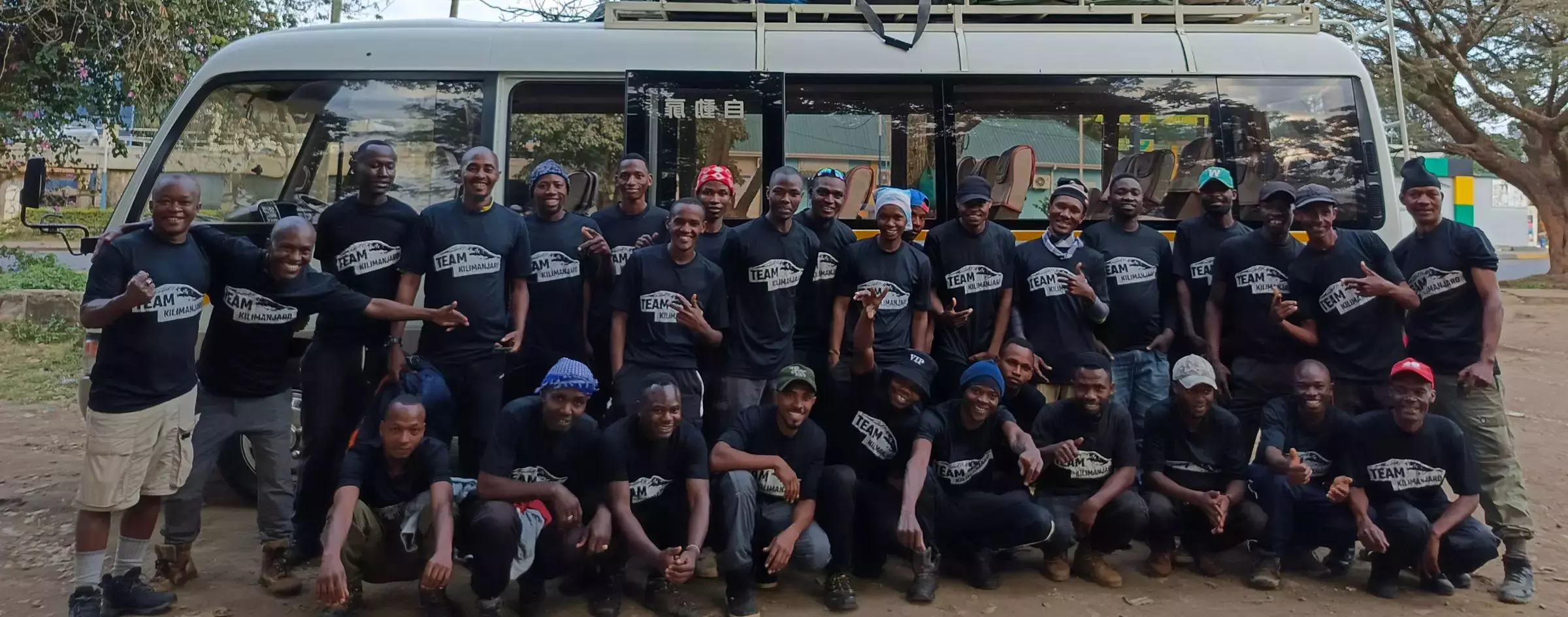
Team Kilimanjaro is an Arusha-based tour operator and the undisputed authority on climbing Kilimanjaro, regularly consulting to the national park authorities on mountain safety, route development, and environmental degradation reduction.
Because of our in-depth, hands-on knowledge of the mountain and unique acclimatisation strategies, TK often support world record attempts - including the first women's speed ascent 🏃♀️(2005), the youngest person to summit Kilimanjaro (aged 5.37 years), the fastest unsupported ascent, and multiple quadriplegic 👨🦽 and amputee ascents.
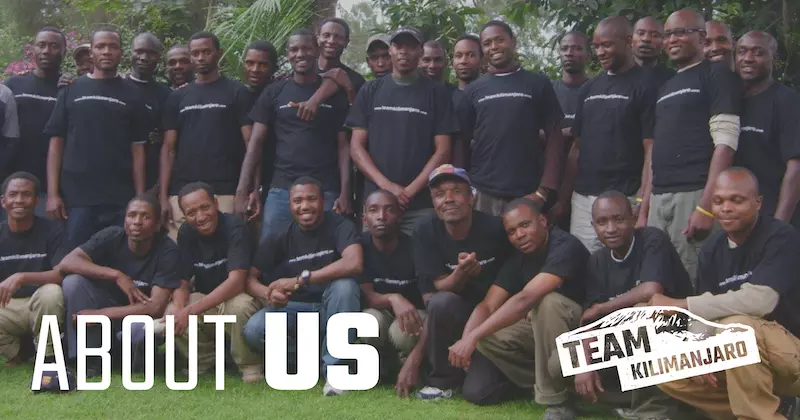
Team Kili have created unique route variants that reduce acute mountain sickness and increase summit prospects, and have helped more than 12,000 trekkers to climb Kilimanjaro since 2004.
Learn more about Team Kilimanjaro 👉
🥾 Climbing Kilimanjaro Successfully
Over the last 21 years one of the most surprising things we’ve seen when witnessing non-TK climbers failing to summit, is
You may have already found the best operator to climb with. However, it's not enough merely to plan to climb Kilimanjaro; you should be planning to summit.
Climbers contact TK because our pioneering methods are unique and have been developed to ensure you have the best chance of reaching the summit.
Learn why you're more likely to summit with TK 👉
"…highly recommended... comes at Kilimanjaro from a whole different angle... Reliable, reasonably priced and delightfully obsessed about the mountain... Overall a great little company and well worth checking out.”
📅 Best time to climb?
This is often one of the first questions we get asked. Happily, the answer is that you can climb Kilimanjaro every single day of the year! 🎆 However, in spite of the fact that if it ain't raining, it ain't training, a lot of people don't like getting heavily rained on when trying to enjoy some of the planet's most breath-taking views.
To cater for those who want to stay reasonably dry, we therefore recommend climbing during the dryer months - January to February, and June to October.
However, there are some important weather-related considerations and other factors that affect our recommendation, such as route selection 🧭 and crowding.
Take a moment to learn more about ❄️ Kilimanjaro's weather 👉and how to avoid the crowds 👉
💵 How much does it cost to climb Kilimanjaro in 2025?
Depending on your group size, chosen route, level of support, and any special extras, the cost to climb with Team Kilimanjaro in 2025 ranges from USD 1,302 to USD 12,873 per person. However, the vast majority of our climbers pay between USD 2,243 and USD 3,169 per person for a fully guided, all-inclusive ascent.
See our detailed Kilimanjaro prices →
Note that this figure covers your in-country climb costs only. There are a few additional expenses to plan for — such as flights, visas, vaccinations, tips, and optional gear hire — which we explain in our full Kilimanjaro cost guide.
🤔 How much money do you need to climb Kilimanjaro?
Since you're not going to be able to take your fancy house, car or clothes to the grave with you, at TK we believe that a life well-lived is all about what you do, not what you have.
So, yes, climbing Kili is certainly an investment, and you may have to forego cluttering-up your house with a few more trinkets to be able to afford it, but it's an investment which our clients repeatedly tell us they wouldn't have given up for anything.
Hi John, i just got down. Absolutely amazing experience from start to finish. Faraja is an absolute legend. One of the best weeks of my life.
When budgeting for a trek, then, you'll also need to consider the following costs. These are very approximated and will obviously differ depending on whether you're flying in from the US, Canada, UK, South Africa, Israel, Malaysia, or Australia:
- Training for Kilimanjaro 👉 to include trips to the hills, fuel and supplies could easily set you back USD 200 - 300
- Flights to Kilimanjaro International Airport 👉 could be around USD 400 - USD 1200 depending on where you fly-in from
- Clothing & equipment for Kilimanjaro 👉 could set you back USD 400 - 1,000, but you can reduce some costs by hiring bulky and occasional use items 👉
- Visa for Tanzania 👉 will cost USD 100 if you're American, or else USD 50
- Tips 👉 to the mountain crew will tend to range from USD 300 - USD 500 per climber, depending on group size and route length - though very occasionally some tip as much as USD 1,000!
So, with the cost of a climb at probably not less than USD 2,300, with these additional costs, you probably need to have not less than USD 3,700 available to climb Kilimanjaro - though possibly quite a bit more with long haul flights and big tips.
🧮 Climbing on a Budget
The first time our founder, John, climbed Kili on 27th March 2000 at the age of 21, he spent only USD 45 on park fees and had no porters - running most of the way up the mountain and reaching the summit from Marangu Gate in just one day, to save costs!
So, while nowadays also offering the highest-end climbs on the market to VIP climbers, Team Kilimanjaro was established on an extremely budget-conscious basis and is therefore sympathetic towards those who need to make a little go far!
There are two ways to climb on a budget:
- If you're very fit you can climb on TK's Superlite Series with only a guide, and no cook or porters. This will mean carrying everything yourself and bringing along your own lightweight foods. Each year we have a handful of climbers who actually prefer the additional challenge of climbing in this way, irrespective of the cost savings to be made.
- You can climb with a budget outfitter, such as our sister operation Kilimanjaro Alpine Service. Like most budget operators, KAS keeps its prices low by using old equipment, cheaper foods and lower-paid staff. However, it benefits from the same exacting oversight and professionalism as TK.
😱 Can you climb Kilimanjaro without a guide?
No. The rules enforced by the park authorities require everyone wanting to climb Kilimanjaro to register their climb through a 100% Tanzanian-owned company that holds a valid Mountain Climbing / Trekking license, and to be accompanied by a Mountain Guide with currently valid guiding license.
For trekkers who are used to planning and executing their own expeditions, carrying their own equipment and navigating for themselves, this regulation may be disappointing. However, it is with these self-sufficient adventurers in mind that Team Kilimanjaro designed the Superlite Series, which is the
👥 Can you climb Kilimanjaro without porters?
Yes! In spite of what you will read on many other tour operators' websites, it is perfectly legal to climb Kilimanjaro without porters - as is done on TK's Superlite Series. If you are willing to carry your own equipment the rules state that you need only have a guide, plus assistant guides for larger groups, in case the party has to fragment - since the authorities do not permit visitors to the mountain to be unaccompanied during any period of movement.
📚 Climb Guide
We are sometimes asked for recommendations on a guide to Kilimanjaro. While it's not really necessary to own one as you'll be accompanied by a human guide who knows the mountain like the back of his hand and possesses detailed knowledge of Kilimanjaro's flora and fauna, some still like to read up on the mountain before they fly out, and to have it handy for referencing. We even keep a copy in our office!
The best guide to climbing Kilimanjaro is undoubtedly the one written by Henry Stedman. Henry regularly travels to Tanzania to update his writing (five editions in 15 years!), and is passionate about the mountain and - while we don't quite agree with everything in his guide - it is diligently researched, lighthearted, and easy to read.
Henry's Kilimanjaro guide covers the standard routes so you won't get any useful information on Team Kilimanjaro's customised routes but there's plenty of useful information on Kilimanjaro's wildlife, history, people and customs; and useful pointers for those spending time in Arusha, Moshi, Marangu and even Nairobi and Dar es Salaam.
⏱️ How long does it take to climb Kilimanjaro?
The park authorities mandate certain minimum timeframes for climbing Kilimanjaro, depending on the route you choose to trek. These are the current minimum timings for each route - including time spent descending:
- Marangu - 5 days
- Rongai - 5 days
- Machame - 6 days
- Umbwe - 6 days
- Lemosho - 7 days
In spite of these minimums trek lengths,
Check out our blog page for more information on how long it takes to climb Kili 👇
📍 Hike Distances
For many who are thinking about a Kilimanjaro trek but have absolutely no idea what's involved, one of the first things they want to know is the hike distance for each route:
- Umbwe Route via Western Breach: 41.5 km / 25.8 miles
- Umbwe Route: 45.6 km / 28.3 miles
- Machame Route: 56.8 km / 35.3 miles
- Standard Rongai Route: 61.6 km / 38.3 miles
- Standard Lemosho Route: 62.0 km / 38.5 miles
- TK Lemosho Route: 66.8 km / 41.5 miles
- Marangu Route: 68.6 km / 42.6 miles
- Standard Rongai Route via Mawenzi Tarn: 69.2 km / 43.0 miles
- TK Rongai Route: 73.0 km / 45.4 miles
Our guides are trained to implement several pro-acclimatisation excursions throughout each trek, so actual distances walked will be longer than those stated above.
You can see these routes superimposed on an interactive map of Kilimanjaro by visiting our routes page.
🗺️ Kilimanjaro Map
Although you don't need to navigate on Kilimanjaro those who are used to leading their own expeditions are in the habit of wanting to know where they're going and usually appreciate having a really accurate map.
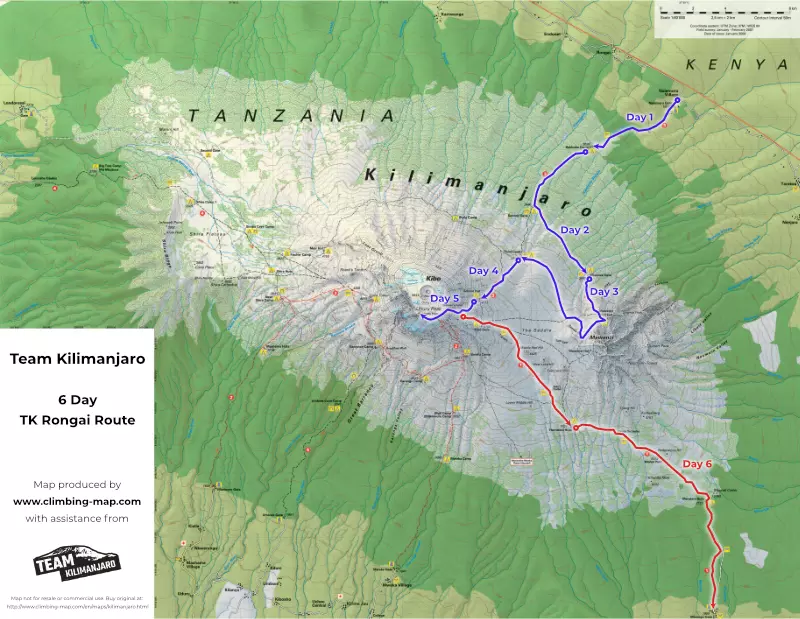
There is only one accurate map that has ever been produced for Kilimanjaro. We know it's accurate (except for the significant misprint on the altitude of Big Tree Camp, and Pofu Camp being omitted) because TK helped to create it.
This map was prepared by Sasha and Sandra, Swiss cartographers, who came to stay with TK in 2007 and were guided by us on seldom-visited trails and with whom we shared our bank of captured GPS data.
With 2 km grid squares and super-clear 50 metre contour increments, it's a beautiful map to own and use. Here's a sample, which serves the dual purpose of showing why Team Kili's hugely successful version of the Rongai Route covers 79 km instead of the standard 62 km 👇
On a mobile and want to see more detailed resolution in this map? Just rotate your phone sideways and back again and pinch to zoom 😉👍
🏃♀️ Preparing to Climb
So, you've decided to climb Kilimanjaro but want to know what you need to do to prepare? It's very straight forward. There are just five simple steps:
- Book your climb. We recommend you do this as early as possible so you're committed and there's no more room to dither and make excuses! It only takes a deposit of USD 150 to secure your place and you can do this by card, quickly and painlessly 😉. Just ask us for a card payment link.
- Start buying your equipment. You don't need to buy everything on Day 1, but we strongly recommend you get your day sack and hiking boots early, so you can break them in, identify any possible problems, and remedy them when you still have plenty of opportunity to look at options. Check out our recommended kit list where we offer suggestions on specific items and where you can download a printable PDF Packing List.
- Start training! Although we do get a few last minute bookings, if you have time to do so,
we recommend starting your training 3 months before you plan to climb - Book your flights Kilimanjaro International Airport (JRO). While we don't necessarily recommend booking your flights many months ahead of travel, it's worth looking at flight prices early so you can get a feel for the price trend and buy when fares are cheapest. Check out our flights page where we review 7 fight comparison sites and offer our recommendations on how to find the cheapest flights to Kili.
- Get your Tanzanian visa. We recommend obtaining your visa ahead of travel so you don't have to queue on arrival. We offer step-by-step guidance on how to apply for your Tanzanian visa online, so it's really simple to do this. It's a good idea to apply for your visa 2-3 weeks before you fly, though you'd usually expect to get it within a week of applying. It'll be valid to stay in Tanzania for 3 months for a visit anytime within a year from application.
🧬 How fit do you have to be to climb Kilimanjaro?
When we recommend that you book your climb at least 3 months in advance and commit to our 12 Week Training Plan, we don't want you to think that climbing Kilimanjaro is only possible for super-fit people. That's definitely not the case and over the years we've assisted many people to the summit who would admit they were in bad shape and didn't find time to train.
The main reason we want our climbers to train is simply because they'll enjoy the experience so much more and remain far more alert to the incredible natural beauty around them.
That said, we recommend you read our suggested minimal health requirements for climbing Kilimanjaro 👉 where we offer a couple of pointers to determine whether you're fit enough to stand a decent chance of reaching the summit.
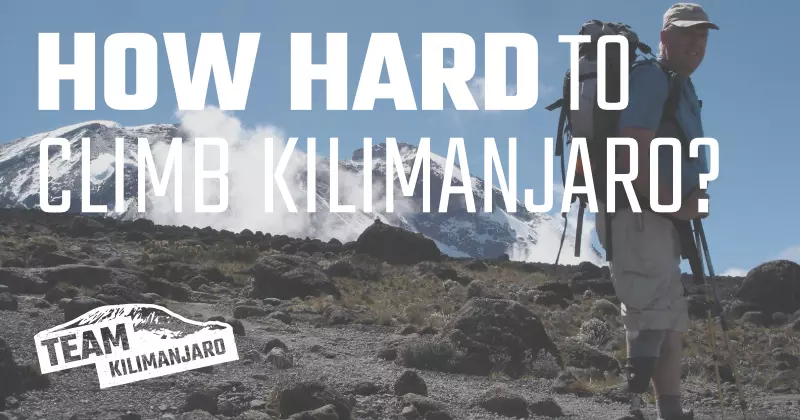
😓 How hard is it to climb Kilimanjaro?
When we say you don't have to be super-fit, it may then sound like a contradiction when we go on to say that for many, many trekkers we're told that
Actually, high altitude is a great leveller. While it is obviously helpful to be fit and while the greatest advantage you can give yourself is to shave off any unneeded bodyweight during the build-up to flying out to Tanzania, the last 500 vertical metres to the summit are a very difficult challenge for everyone and should not be underestimated.
Read some more in-depth information about how difficult it is to climb Kilimanjaro 👉
🥺 Climbing for Charity
Kilimanjaro climbers are generally special people, the kind of people who think about what's important in life.
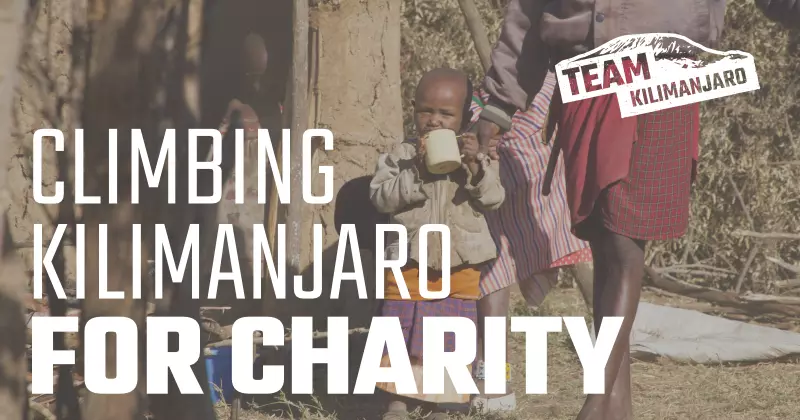
After all, why train, plan, prepare and fly out to a hostile wilderness environment, volunteer to suffer discomfort and privations, and deliberately do one of the most difficult things most people will do in their lives, unless you're the kind of person that thinks that happiness and meaning in life have far more to do with giving than taking.
We assist two different charities in Arusha, where we're based - an orphanage and a school - and would love for you to dedicate your climb to raising funds for one of them, as money spent on these causes will go further and be put to better use than pretty much anywhere else that we could imagine in the world.
That said, some climbers already have a benefit in mind when they plan to climb for charity, and we have a scheme that fits that option also.
Learn more about climbing Kilimanjaro for charity 👉
💉 Climbing Kilimanjaro During COVID-19
The Tanzanian government is now taking COVID-19 seriously. That said, it is an outdoor and agrarian society, with an active, healthy and well-nourished population, plenty of space, temperate weather and virtually no crowded or heavily built-up areas - so transmission is deemed to be far less a risk than in heavily developed countries - and we are still yet to see a single positive PCR test result, even though TK organises PCR tests in Arusha for clients of many other companies, several times a week.
👮🏾♀️ Current COVID-Related Visitor Requirements
The following is extracted from the Tanzanian government's most recent travel advisory as at 11th May 2023, but in 2025 we're not seeing any evidence of these measures persisting:
01 - All travellers entering or transiting URT through land borders, sea ports or airports are advised to be fully vaccinated as per approved schedule of primary vaccination against COVID 19 in their respective countries.
02 - All travellers entering or transiting URT Mainland through land borders, sea / lake ports or airports are not required to present a COVID - 19 vaccination certificate or RT-PCR certificate or perform Rapid Antigen Test on arrival unless stated otherwise by conveyance to be used or country of their final destination. However, for surveillance purposes Port Health Officials may at any time perform COVID-19 Rapid Antigen Test free of charge for randomly selected travellers during arrival at points of entry.
03 - On arrival, thermal and physical screening will be done. Passengers found to be symptomatic during screening will be immediately isolated and handled as per health protocol.
04 - All travellers departing from Tanzania should seek information prior to departure from their travel agents regarding COVID-19 requirements of their country of destination or conveyance to be used.
05 - For travellers departing from Tanzania whose conveyances and destination countries require RT- PCR certificates, test will be done at designated places at their own cost of TZS 115,000 (50 USD) or perform Rapid Antigen Test before departure at their own costs of TZS 23,000 (10 USD).
06 - All travellers should self-monitor their health post arrival and shall report to their nearest health facility or call Toll Free Health Emergency Number: 199 for Tanzania Mainland.
NB: This Travel Advisory will be reviewed from time to time as need arises.
⛰️ Mount Kilimanjaro Facts
Location
Kilimanjaro sits entirely within the borders of Tanzania, just 3 degrees south of the equator.
What's the closest airport to Kilimanjaro?
The closest airport to Kilimanjaro is Kilimanjaro International Airport, airport code 'JRO'. Confusingly, flight booking sites have recently started referring to JRO as 'Arusha'. But actually, there's another airport in Arusha with airport code 'ARK'.
How high is Kilimanjaro?
The altitude of Kilimanjaro's summit, Uhuru Peak, is 5,895 metres or 19,340 feet.
Does it snow on Kilimanjaro?
Yes, it can snow on Kilimanjaro throughout the year from around 4,600 metres and upwards. But snow is primarily associated with Kilimanjaro during the two wet seasons of April to May and November to early December.
Can a beginner climb Kilimanjaro?
There is nothing to prevent a beginner from climbing Kilimanjaro. You don't need any experience of altitude, or even of trekking. There's nothing technical or vertical along any of the routes, and only a couple of metres of scrambling at just one point on the Umbwe Route.
Why is Kilimanjaro famous?
Kilimanjaro's fame is primarily due to its being the highest mountain in Africa and the largest freestanding mountain the world - rising 5,118 metres from it's base.
Why is there snow on Kilimanjaro?
In spite of being so close to the equator, above 5,000 metres altitude the temperature stays below freezing nearly all the time. Because of this, precipitation - which occurs mainly during April, May, November and December - falls as snow.
Do you need oxygen to climb Kilimanjaro?
No. Oxygen is generally only necessary when ascending mountains about 7,000 metres. It is however recommended to carry supplemental oxygen for use in emergencies and to aid safe descents if a climber has succumbed to severe acute mountain sickness or has symptoms of high altitude pulmonary or cerebral oedema.
How cold is Kilimanjaro at the top?
On 'Uhuru', the peak of Kilimanjaro, it's usually around -6°C / 21°F, but with windchill, the temperature will often drop to around -10°C / 14°F.
What animals live on Kilimanjaro?
Commonly seen are the four-striped grass mouse, harsh furred mouse, climbing mouse, mole rat, blue monkey, colobus monkey, bush pig, bushbaby, small-spotted genet, tree hyrax, buffalo.
There are rare sightings of the olive baboon, civet, leopard, mongoose, serval, aardvark and honey badger.
Birds seen are the lammergeyer, scarlet tufted malachite sunbird, streaky seed eater, white-necked raven, Hartlaub's turaco, speckled mousebird, tropical boubou, silvery cheeked hornbill, montane white-eyes, common stonechat, trogan, Ruppell's robin chat, common bulbul, alpine chat, streaky seed-eater, augur buzzard, and crowned eagle.
What does the name 'Kilimanjaro' mean?
None of the locals are really sure what the name 'Kilimanjaro' actually means, but since the tribe that inhabits its foothills is the Chagga, and since the Chagga word for white is very similar to 'njaro', it's a reasonable guess that an earlier form of the language would have rendered 'white mountain' as kilima njaro.
When was Kilimanjaro first climbed?
No-one knows for certain when Kilimanjaro was first climbed. Many locals believe it was climbed by one of the sons of Solomon and the Queen of Sheba! However, in modern history the first people known to have climbed it were Hans Meyer, Ludwig Purtscheller and their guide Yohani Kinyala Lauwo on 6th October 1889 (a descendant of whom named Abel Lauwo, still works as a guide on the mountain today).
Who was the youngest person to summit Kilimanjaro?
The youngest person known to have reached the summit of Kilimanjaro is Bran Rees-Evans who was 5 years 136 days old when he summited at 1345 on 26th November 2012. Exactly two weeks earlier he had just become the youngest person to summit Mount Meru at 4,566 metres altitude.
Who was the fastest person to ascend Kilimanjaro?
So far, all speed ascents have started from one of the park gates, which are generally already around a quarter of the way up Kilimanjaro from its base. However, the fastest ascent of Kilimanjaro from the park boundary to the summit was achieved by Karl Egloff in 4 hours 56 minutes.
Team Kilimanjaro is currently planning the first complete speed ascent of Kilimanjaro from a point reckoned to lie on the perimeter of its base, just outside Himo at 777 metres altitude.
Read more facts about Kilimanjaro 👉
✔️ Quick Reference - Page Contents
🎬 Ready to climb?
So if you're ready to climb Kilimanjaro or would like some advice or guidance on how to plan your expedition to the most exciting and hospitable country in Africa, then don't delay! Get in touch with TK today.

Most Kilimanjaro trekkers begin their summit push shortly after midnight. When this ascent coincides with a full moon, the mountain is illuminated naturally, giving far brighter visibility, clearer paths, and a more spectacular horizon. Below is the complete list of the best full moon summit nights for 2025 and 2026 to help you plan your climb.

For some climbers this question is almost irrelevant as they will have to fit their climb into whatever dates they can clear from their busy work or family schedules, though for perhaps the majority, this is probably the first question prospective climbers should ask themselves.

You don't need to climb on the dates shown below—we publish these only for those who would like to join other trekkers they don't already know. Most of our clients choose their own dates at no additional cost, although many ask us to open their climb for others to join for some extra company. If you do join a group, you won't need to worry about crowds: except by special agreement, our climbs are limited to just 8 trekkers, allowing the guide to closely monitor everyone, attend to individual needs, and give each person plenty of opportunity to speak with them.